Docs
Evidence
Species panel/Evidence
Why should a reviewer trust that a species is really present? Every occurrence claim behind it is mapped and sourced, so "high evidence" is something you can see on the map, not just a badge you have to take on faith.

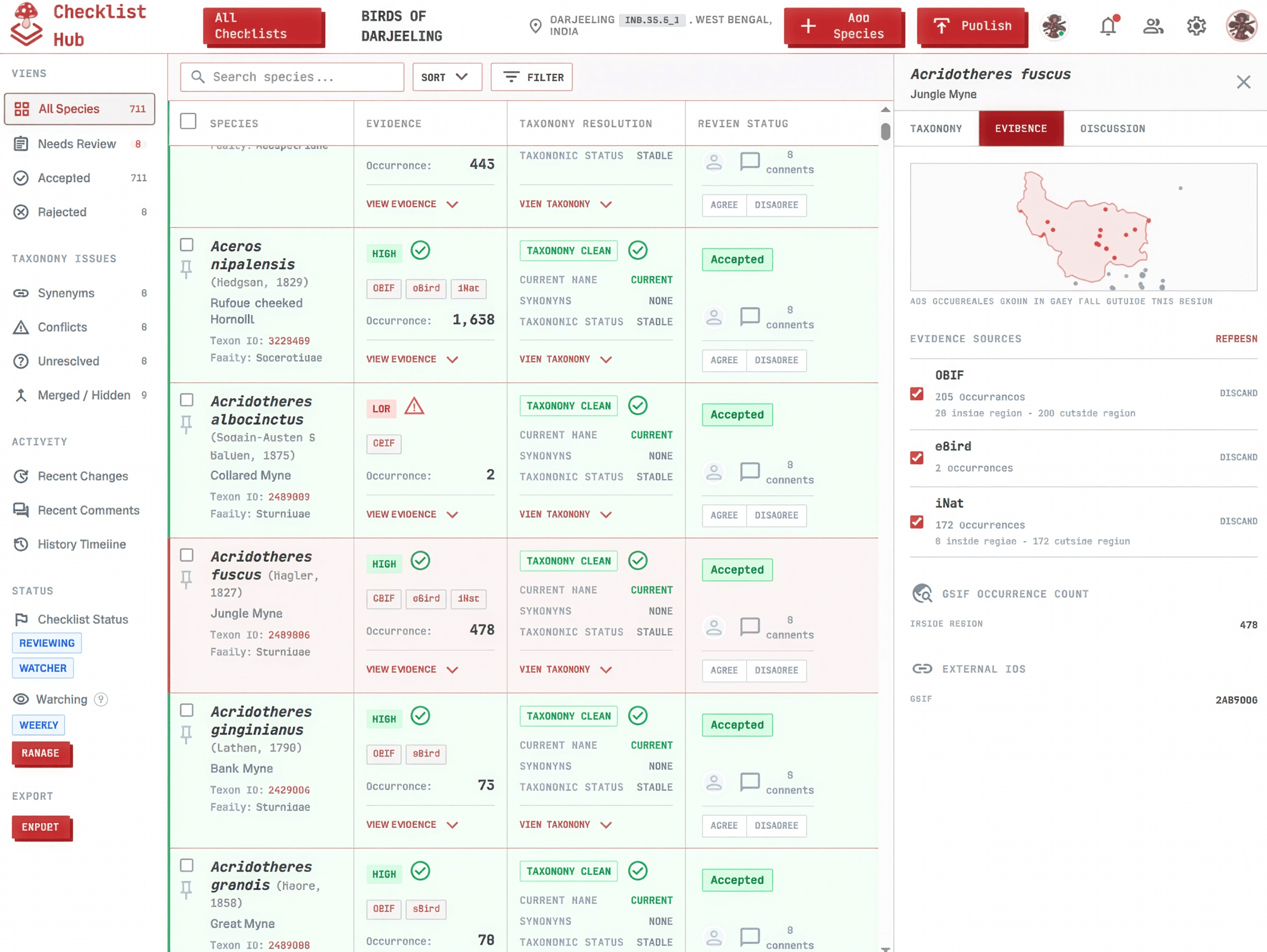
Click a step below to see it highlighted in the screenshot.
- 1
The region, drawn to scale
The checklist's boundary is pulled from GADM and drawn on the map. Every occurrence point, from GBIF, eBird, iNaturalist, and literature, is projected onto it and colored by source, with points that fall outside the boundary shown separately so you can spot bad geocoding at a glance.
- 2
Sources, with counts
GBIF, eBird, iNaturalist, and literature are each listed with an occurrence count, split into inside-region and outside-region totals.
- 3
Discard a bad source
Found a source that's wrong for this species? Discard it, the evidence strength recalculates immediately, and it can be restored later without losing history.
- 4
Refresh and trace back
Refresh re-pulls the latest counts on demand, and external IDs, like the GBIF taxon key, link straight back to the source record.
What Low, Medium, and High Mean
The badge on every Workbench row isn't a judgment call, it's a score built from the active sources on that species:
- Literature and eBird records count for 3 points each, GBIF and iNaturalist records count for 2, and legacy records count for 0.
- A source past 20 occurrences adds 1 point, and past 100 adds 2.
- Every independent source beyond the first adds 1 point, since two sources agreeing is stronger than one source saying it twice.
6 points or more
3 to 5 points
Under 3 points
Evidence grows on its own, too
A weekly or monthly Watcher run re-fetches these same counts from GBIF, iNaturalist, and eBird. When it finds new occurrences for a species already on the checklist, the score recalculates against the new totals, so a Low or Medium species can climb between reviews, purely because more evidence turned up in the field. See Features → Watcher for how a run is set up and applied.